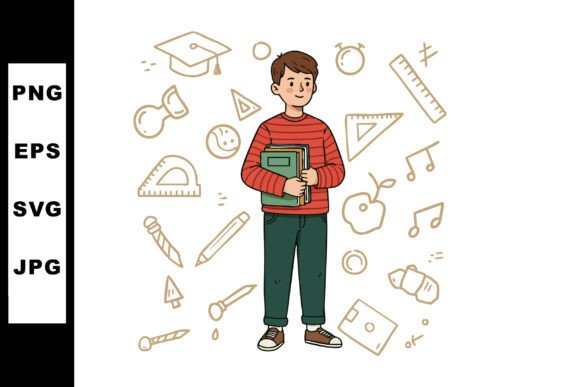
Boy Holding Books with School Supplies: A Strategic Visual Asset for Education and Learning Projects
In the realm of digital design and content creation, the selection of visual assets is rarely just an aesthetic choice; it is a strategic decision that influences user engagement, brand perception, and communication clarity. The illustration known as Boy Holding Books with School Supplies represents more than a simple depiction of a student. It serves as a versatile iconographic element designed to communicate themes of education, academic success, preparation, and intellectual growth within a clean, modern style. For professionals ranging from educators and marketers to entrepreneurs and publishers, understanding how to integrate this specific asset into broader workflows can significantly enhance the efficiency and impact of their projects.
This visual resource typically arrives as a comprehensive downloadable ZIP package containing SVG, EPS, JPG, and PNG files. This multi-format delivery is not merely a convenience; it is a critical component of a robust asset management strategy. By providing vector formats like SVG and EPS alongside raster formats like JPG and PNG, the asset ensures compatibility across various stages of a production pipeline, from initial concepting in vector software to final deployment on web platforms or print materials. Understanding the utility of each format allows creators to maintain high quality control while optimizing for speed and usability.
Defining the Role of Educational Imagery in Content Strategy
Before integrating any visual into a project, it is essential to define its role within the narrative structure. The Boy Holding Books with School Supplies illustration functions as a semantic anchor. In the context of educational marketing, e-learning platforms, or back-to-school campaigns, this image immediately signals relevance to the audience. It bypasses the need for extensive textual explanation by leveraging universally recognized symbols: books representing knowledge, school supplies indicating readiness, and the figure of the boy embodying the learner.
For content creators and strategists, this type of imagery fits into the "preparation" phase of a project. When planning a curriculum guide, a tutoring service landing page, or a blog post about study habits, selecting the right visual establishes the tone before a single word is read. The clean style of this particular illustration ensures it does not overwhelm the surrounding text or interface elements. Instead, it complements the content, reinforcing the message of focus and creativity without introducing visual clutter. This alignment between visual simplicity and communicative power is what makes the asset valuable for professionals who prioritize clarity and directness in their work.
Workflow Integration Across Different Project Stages
The versatility of the Boy Holding Books with School Supplies asset allows it to be utilized effectively at multiple points in a creative or business workflow. Its application varies depending on whether the project is in the ideation, execution, or distribution phase.
Ideation and Conceptual Planning
During the initial planning stages, designers and marketers often use mood boards to visualize the direction of a campaign. Incorporating this illustration early helps stakeholders align on the desired aesthetic. Because the image features a clean style, it suggests a modern, professional approach to education rather than a cartoonish or overly playful one. This distinction is crucial for B2B educational services or adult learning programs where credibility is paramount. Using the SVG file during this stage allows for quick resizing and color adjustments to test different brand alignments without losing resolution.
Execution and Asset Production
Once the concept is approved, the execution phase demands technical precision. Here, the inclusion of EPS and SVG files becomes vital. Vector formats are scalable, meaning the illustration can be resized for a small social media icon or a large billboard without pixelation. For graphic designers working in Adobe Illustrator or CorelDRAW, the EPS file provides editable paths, allowing for minor customizations such as changing the color palette to match corporate branding or adding specific text overlays directly onto the artwork. This flexibility reduces the need to commission new illustrations for every variation, streamlining the production timeline and reducing costs.
Distribution and Deployment
In the final distribution stage, the JPG and PNG files take center stage. Web developers and social media managers require raster images optimized for screen display. The PNG format, with its support for transparency, is particularly useful for overlaying the illustration on top of colored backgrounds or complex layouts. Conversely, the JPG format offers smaller file sizes, which is beneficial for maintaining fast page load times on educational websites or blogs. By having these formats readily available in the original download, teams can avoid the time-consuming process of re-exporting and converting files, ensuring a smoother rollout across multiple channels.
Compatibility and Technical Considerations
A common challenge in digital workflows is ensuring that visual assets remain consistent across different platforms and devices. The Boy Holding Books with School Supplies package addresses this through its diverse file structure. However, successful implementation requires an understanding of how these formats interact with various tools.
- Vector Compatibility (SVG/EPS): These files are ideal for print production and high-resolution displays. They interact seamlessly with desktop publishing software and vector editing suites. For long-term use, storing the master vector files in a centralized asset library ensures that future updates or rebranding efforts can be made efficiently.
- Raster Utility (JPG/PNG): These are best suited for immediate web use, email newsletters, and social media posts. The key here is organization. Teams should establish a naming convention for these files to prevent version confusion, especially when multiple team members are accessing the same resources.
- Cross-Platform Consistency: When deploying the asset across mobile apps, websites, and printed brochures, the clean lines of the illustration ensure it remains legible at various scales. This consistency reinforces brand identity and prevents the disjointed look that often results from using low-quality or mismatched graphics.
Practical Implementation Tips for Professionals
To maximize the value of this visual asset, professionals should adopt a systematic approach to its usage. One effective method is to treat the illustration as a modular component within a larger design system. For example, a publisher creating a series of educational guides might use the Boy Holding Books with School Supplies image as a recurring motif on chapter headers or cover designs. This repetition creates a cohesive visual language that readers can easily recognize and associate with the brand.
Furthermore, consider the context of the accompanying content. If the text focuses on the challenges of learning, the image can serve as a counterpoint, symbolizing hope and preparedness. If the content is instructional, the image acts as a visual cue that the reader is entering a learning environment. Marketers should also analyze the emotional resonance of the image. The focused mood depicted in the illustration appeals to parents seeking serious educational resources and students looking for motivation. Aligning the visual with the emotional intent of the copy enhances the overall persuasive power of the message.
Efficiency in the workflow also depends on proper file management. Upon downloading the ZIP file, it is advisable to extract the contents into a dedicated folder structure within your project directory. Separate the vector masters from the web-ready rasters. This organization prevents accidental overwriting of source files and ensures that the correct format is selected for each specific task. Additionally, documenting the license terms and usage rights associated with the asset is a critical step for compliance, particularly for commercial projects involving clients or public distribution.
Long-Term Value and Scalability
The true measure of a high-quality asset lies in its longevity and adaptability. The Boy Holding Books with School Supplies illustration, with its timeless subject matter and clean execution, offers significant long-term value. Unlike trend-heavy graphics that may date quickly, this style remains relevant across years of educational cycles. This durability means that the initial investment in acquiring and integrating the asset yields returns over an extended period.
As organizations grow and their needs evolve, the scalability of the vector formats ensures the asset can adapt to new requirements. Whether expanding into international markets requiring translation and layout changes or shifting to new digital platforms with different aspect ratios, the underlying vector data supports these transitions without degradation. For freelancers and small business owners, this scalability translates to cost savings and operational agility. Instead of constantly searching for new visuals, they can rely on a core set of proven assets that perform consistently well.
Ultimately, the integration of Boy Holding Books with School Supplies into a professional workflow is about more than just finding a picture. It is about selecting a tool that facilitates clear communication, supports efficient production processes, and maintains high standards of quality. By understanding the technical capabilities of the provided file formats and strategically applying the visual to appropriate contexts, creators can elevate their projects, engage their audiences more effectively, and streamline their own operations. In a landscape where attention is scarce, utilizing precise, meaningful, and technically sound visual assets is a decisive factor in achieving project success.