Science Lab Tools Sublimation: A Practical Evaluation
For educators, crafters, and small business owners, the intersection of scientific accuracy and artistic expression often presents a unique challenge. The Science Lab Tools Sublimation collection addresses this niche by offering a specific set of digital assets designed for transfer onto physical goods. This article evaluates the utility, application, and limitations of using watercolor-style laboratory equipment graphics for sublimation printing and other creative projects.
Understanding Science Lab Tools Sublimation Assets
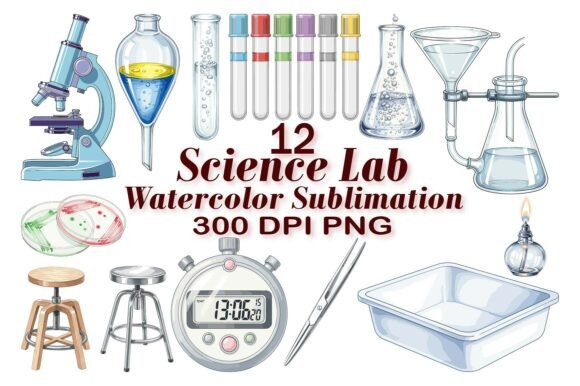
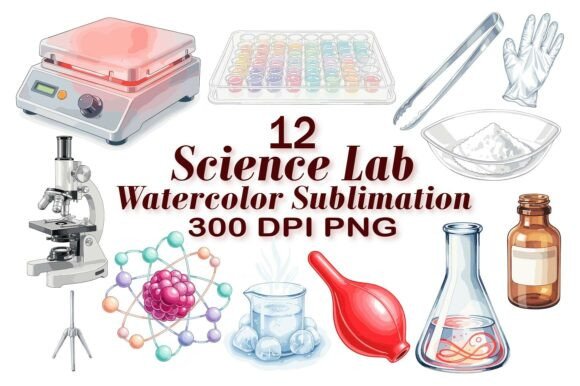
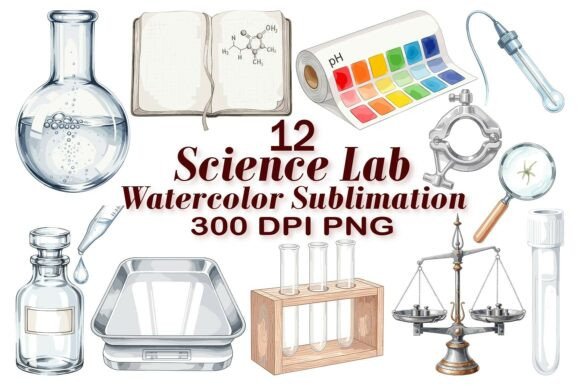
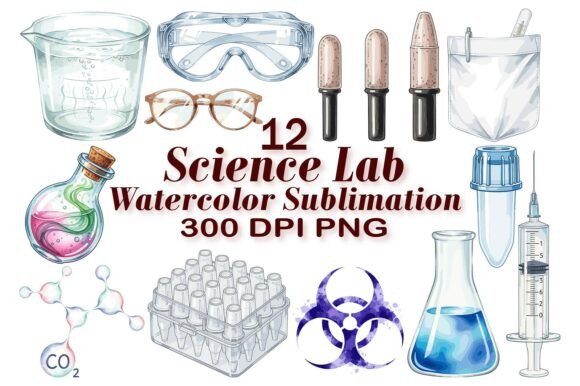
The term "Science Lab Tools Sublimation" refers to a digital bundle of high-resolution images depicting essential laboratory equipment, rendered in a watercolor aesthetic. Unlike standard vector clipart or photographic representations, these assets utilize soft edges, color blending, and organic textures typical of watercolor painting. The collection typically includes items such as beakers, safety goggles, flasks, syringes, molecules, centrifuge tubes, and test tube racks.
These files are formatted as PNGs with transparent backgrounds, allowing them to be layered over various design elements without obstruction. The technical specifications usually involve dimensions of 5000 x 5000 pixels at 300 DPI. This resolution is critical because sublimation printing relies on transferring ink directly into the substrate (such as polymer-coated mugs or polyester fabrics) under heat and pressure. If the source image lacks sufficient pixel density, the final print may appear pixelated or blurry, particularly when scaled up for larger products like posters or banners.
Why Consider This Specific Style?
There are several practical reasons why an individual might choose this specific style of scientific illustration over others. The primary driver is often the aesthetic requirement for educational or decorative materials. Standard line drawings or photorealistic images can sometimes feel sterile or overly clinical. In contrast, the watercolor style introduces warmth and approachability, making complex scientific concepts more inviting for younger audiences or for use in home decor.
Educators frequently seek resources that can transform a classroom environment into an engaging space. Using these graphics on sticker packs, greeting cards, or scrapbooking elements allows teachers to create custom rewards or learning aids that stand out. Similarly, event planners organizing science-themed weddings or birthday parties may find that the artistic nature of these illustrations bridges the gap between a technical theme and a celebratory atmosphere.
Furthermore, the versatility of the PNG format allows for rapid prototyping. Designers can quickly place these elements onto mockups for mugs, T-shirts, or wedding invitations to visualize the final product before committing to production runs. This efficiency is valuable for those operating on tight deadlines or managing multiple custom orders.
Benefits and Technical Advantages
The most significant benefit of utilizing a dedicated Science Lab Tools Sublimation bundle is the optimization for print quality. With a resolution of 300 DPI, the files meet the industry standard for professional printing. This ensures that fine details, such as the measurement lines on a beaker or the structure of a molecule, remain crisp even after the heat transfer process.
Another advantage is the cohesive visual language provided by a single collection. When designing a series of products—such as a set of posters or a matching set of printable decorations—consistency in style is crucial. Mixing different art styles can result in a disjointed appearance. A curated bundle ensures that all elements, from the pocket protector to the biohazard symbol, share the same color palette and texture profile, creating a unified brand or thematic identity.
Additionally, the transparency of the PNG files simplifies the design workflow. Users do not need advanced photo editing skills to remove white backgrounds. This accessibility lowers the barrier to entry for hobbyists who may not have professional graphic design software but still wish to produce high-quality sublimation prints.
Tradeoffs and Limitations
While the watercolor style offers distinct aesthetic benefits, it is not suitable for every application. One notable tradeoff is the lack of scalability inherent in raster images. Although 5000 x 5000 pixels is large, it is not infinite. If a user attempts to stretch a single element to cover a very large banner or a full-size T-shirt back print, the image may eventually lose clarity. Vector-based alternatives would allow for unlimited scaling without quality loss.
Color fidelity is another consideration. Watercolor illustrations rely on subtle gradients and color bleeding effects. Depending on the sublimation printer, ink type, and the substrate being used, these delicate nuances may shift during the transfer process. Polyester fabrics generally hold vibrant colors well, but darker substrates or non-polyester materials may require special coatings or result in muted tones compared to the digital preview.
Furthermore, the artistic interpretation means these tools are not intended for technical diagrams. If the goal is to teach students how to properly read a graduated cylinder or identify specific chemical structures with precision, a stylized watercolor image may introduce inaccuracies. In strictly instructional contexts where exactness is paramount, these artistic representations should be used with caution or supplemented with precise diagrams.
When Is This the Right Choice?
The Science Lab Tools Sublimation collection is an excellent fit for scenarios where aesthetics take precedence over technical precision. It is ideal for:
- Educational Decor: Creating bulletin board displays, classroom signs, and motivational posters that make science look fun and accessible.
- Personalized Gifts: Producing custom mugs, tote bags, or T-shirts for scientists, chemistry teachers, or students graduating from STEM programs.
- Event Stationery: Designing birthday cards, invitations, and party favors for science-themed celebrations.
- Craft Projects: Enhancing scrapbooking layouts or creating DIY stickers for journals and planners.
In these situations, the ability to quickly assemble a visually appealing design using pre-made, high-quality assets outweighs the need for editable vector paths or photorealism.
When to Consider Alternatives
Conversely, there are situations where alternative resources may be more appropriate. If the project requires the text within the image to be editable, or if the shapes need to be resized drastically beyond their original dimensions, vector formats (such as SVG or EPS) are superior. Additionally, for medical or industrial applications where accurate representation of equipment is a safety requirement, realistic photographs or technical line drawings are necessary.
If the target audience expects a modern, sleek, or minimalist look, the organic and textured nature of watercolor art might clash with the desired brand identity. In such cases, flat design icons or 3D renders could provide a more contemporary feel. Finally, if the printing method does not support sublimation (e.g., printing on cotton without a coating), the specific optimization for sublimation becomes less relevant, and general-purpose printables might suffice.
Practical Decision-Making Insights
Before investing time or resources into a Science Lab Tools Sublimation project, it is prudent to evaluate the end goal. Ask whether the priority is visual appeal or technical accuracy. For most creative and educational marketing purposes, the balance struck by watercolor illustrations is highly effective. However, always verify the compatibility of the files with your specific printing setup.
Test prints are essential. Even with 300 DPI files, color shifts can occur during the sublimation process. Printing a sample on the actual material intended for the final product will reveal how the watercolor textures translate to the physical medium. By understanding both the capabilities and the constraints of these digital assets, creators can make informed decisions that align with their project requirements and ensure professional results.