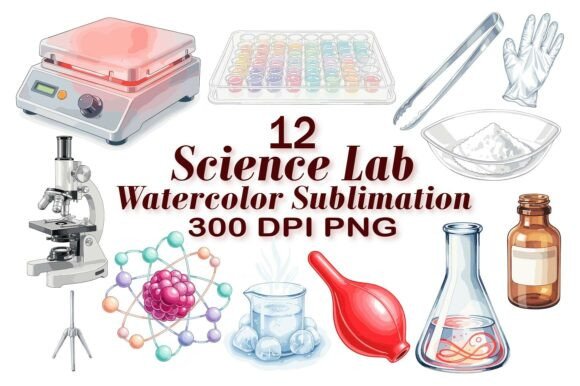
Science Lab Watercolor Designs: A Practical Guide for Creators and Educators
In the realm of digital asset creation and educational resource development, the choice of visual style often dictates the tone and reception of a project. Science Lab Watercolor Designs represent a specific aesthetic niche that bridges the gap between rigorous scientific accuracy and approachable artistic expression. For professionals ranging from STEM educators to small business owners in the print-on-demand sector, these assets offer a versatile solution for communicating complex concepts without overwhelming the audience with sterile technical diagrams. This article explores how integrating high-quality watercolor illustrations into your workflow can streamline production, enhance brand identity, and improve engagement across various platforms.
The Role of Artistic Assets in Scientific Communication
When planning an educational curriculum or launching a science-themed product line, the visual language you choose serves as the first point of contact with your audience. Traditional clip art often feels dated or overly simplistic, while photorealistic imagery can sometimes be too dense for quick comprehension. Science Lab Watercolor Designs occupy a middle ground that is both visually appealing and functionally clear. The soft edges and fluid textures of watercolor soften the perceived complexity of laboratory equipment, making subjects like chemistry and biology feel more accessible to students, hobbyists, and general consumers alike.
This aesthetic choice is not merely decorative; it is a strategic decision in the design process. By utilizing watercolor styles, creators can evoke a sense of curiosity and discovery. In an educational setting, this can reduce anxiety around difficult topics. In a commercial context, such as creating apparel or home decor, it transforms functional items like microscopes and flasks into conversation-starting art pieces. Understanding this psychological impact allows marketers and educators to align their visual assets with their broader goals, whether that is fostering student interest or driving sales through unique, high-quality merchandise.
Evaluating Quality and Technical Specifications
Before integrating any digital asset into a professional workflow, a thorough evaluation of its technical specifications is essential. The effectiveness of Science Lab Watercolor Designs relies heavily on resolution and file format. High-resolution files are non-negotiable for physical printing applications. The collection features 12 distinct PNG files, each sized at 5000 x 5000 pixels with a crisp 300 DPI resolution. This specification is critical because it ensures that the artwork remains sharp and detailed when scaled up for large-format prints or downsized for intricate details on smaller items.
For entrepreneurs using sublimation printing, the transparency of PNG files is a significant advantage. Unlike JPEGs, which include white backgrounds that can interfere with the transfer process, PNGs allow for seamless integration onto colored substrates. Whether you are printing on a dark-colored t-shirt or a ceramic mug, the clean edges of these watercolor illustrations ensure a professional finish. During the preparation phase of a project, verifying these specs prevents costly reprints and maintains the integrity of the final product. It is a fundamental step in quality control that separates amateur projects from professional-grade outputs.
Integration into Educational Workflows
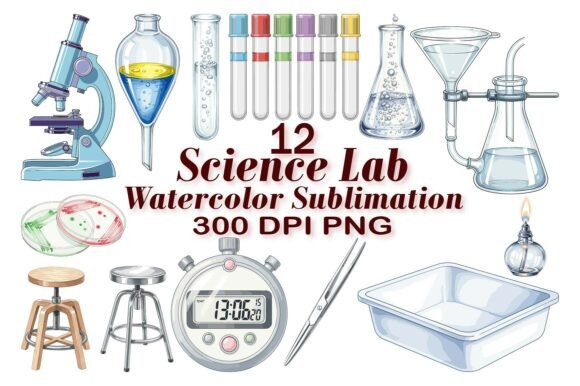
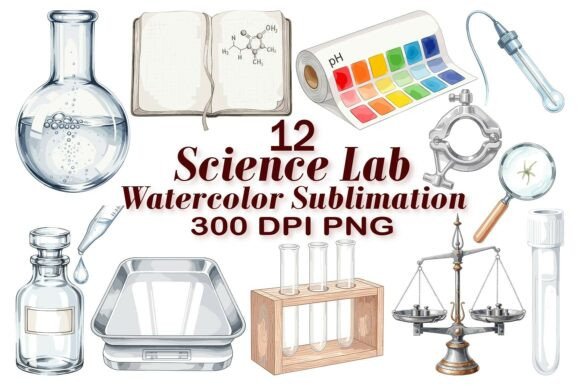
For teachers, instructional designers, and publishers, the implementation of Science Lab Watercolor Designs can significantly enhance the creation of learning materials. These assets fit naturally into the pre-production phase of lesson planning. When designing worksheets, posters, or presentation slides, having a consistent visual library saves time and ensures thematic cohesion. Instead of searching for disparate images that may vary in style or quality, educators can rely on a curated bundle that includes essential items like hot plates, well plates, beakers, and tripods.
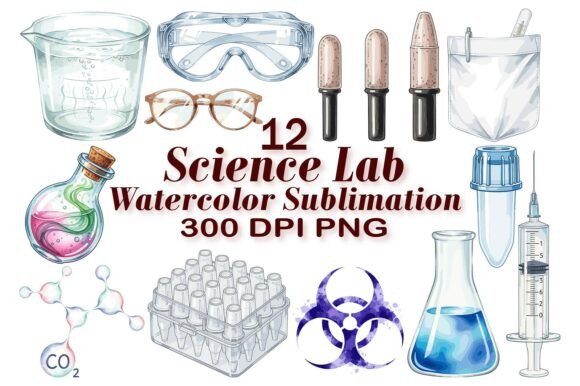
The versatility of these designs supports various teaching methodologies. They can be used as standalone illustrations in textbooks, as interactive elements in digital quizzes, or as decorative borders for classroom decorations. Furthermore, the inclusion of abstract scientific concepts, such as atoms and molecules, rendered in a watercolor style, helps visualize invisible phenomena. This aids in scaffolding learning, allowing students to grasp complex ideas before moving on to detailed chemical structures. By incorporating these assets early in the curriculum design process, educators create a unified visual environment that reinforces the subject matter without distracting from the core content.
Commercial Applications and Product Development
In the commercial sector, particularly for those involved in print-on-demand (POD) and custom merchandise, Science Lab Watercolor Designs serve as a foundational element for product differentiation. The market for science-themed apparel and gifts is competitive, and generic vector graphics often fail to capture consumer attention. Watercolor illustrations offer a handcrafted, artisanal feel that appeals to a wide demographic, including scientists, students, and science enthusiasts.
The workflow for utilizing these assets typically begins with identifying a target niche. Are you targeting wedding invitations for newlyweds who met in the lab? Birthday cards for a chemistry teacher? Or perhaps stickers for a university science department? Once the niche is defined, the specific PNG files can be selected and arranged. The high resolution allows for flexibility in placement; a single flask illustration can be centered on a tote bag, repeated as a pattern on a notebook cover, or combined with other elements to create a complex scene. This adaptability reduces the need for extensive graphic design work, allowing creators to focus on layout and marketing strategies rather than drawing from scratch.
Optimizing Your Creative Process
To maximize the utility of Science Lab Watercolor Designs, it is beneficial to establish an organized file management system. With 12 high-resolution files, keeping them categorized by type—such as glassware, instruments, or molecular structures—streamlines the selection process during busy project deadlines. Many designers also find it useful to create templates in their preferred software, such as Adobe Illustrator or Canva, where these PNGs can be quickly dragged and dropped. This pre-planning reduces friction in the execution phase, ensuring that the creative energy is spent on composition and color theory rather than file hunting.
Compatibility with various printing methods is another factor to consider during the planning stage. While these designs are optimized for sublimation, they are equally effective for screen printing, vinyl cutting, and standard inkjet printing. However, the workflow may differ slightly depending on the method. For instance, sublimation requires the image to be mirrored before printing, whereas direct-to-garment printing does not. Understanding these nuances ensures that the final output matches the intended vision. Additionally, testing a small batch before committing to a full production run is a prudent step in maintaining quality standards.
Strategic Use Across Different Platforms
The application of these designs extends beyond physical products into the digital realm. Bloggers and social media managers in the STEM space can use these illustrations to break up text-heavy posts, create engaging infographics, or design eye-catching thumbnails for video content. The artistic nature of watercolor makes it stand out against the often stark, data-driven visuals common in science communication. This contrast can increase click-through rates and time spent on page, contributing to better overall engagement metrics.
Furthermore, these assets can be repurposed for different campaigns throughout the year. A design featuring a microscope might be central to a back-to-school campaign, while a flask filled with colorful liquid could anchor a holiday greeting card series. This longevity and adaptability make the investment in a high-quality bundle highly efficient. By treating these images as modular components of a larger brand identity, creators can maintain consistency across all touchpoints, from website headers to packaging labels.
Ensuring Long-Term Value and Consistency
Investing in a cohesive set of Science Lab Watercolor Designs provides long-term value by establishing a recognizable visual signature. As a business or educational program grows, maintaining visual consistency becomes increasingly important. Using a dedicated set of assets ensures that all materials, regardless of when they were produced, share a common aesthetic DNA. This consistency builds trust with the audience and reinforces brand recognition.
Moreover, the high resolution of these files future-proofs the assets. As printing technologies advance and demand for higher quality increases, having source files at 5000 x 5000 pixels ensures that the designs remain viable for years to come. There is no need to revisit the search for new images if the current library covers the necessary range of equipment and concepts. This foresight in asset acquisition simplifies future project planning and reduces the administrative burden of managing multiple licenses or subscriptions.
Ultimately, the successful integration of Science Lab Watercolor Designs depends on understanding their role within the broader creative ecosystem. Whether used to illuminate a complex biological concept for a classroom or to add a touch of whimsy to a science-themed t-shirt, these assets offer a practical, high-quality solution for modern creators. By focusing on technical quality, strategic application, and organized workflow management, users can fully leverage the potential of these illustrations to achieve their professional and educational objectives.