Science Lab Watercolor Clipart: A Practical Guide for Designers and Educators
In the realm of digital design, particularly for educational resources and creative apparel, the choice of visual assets can significantly impact the final product's reception. Science Lab Watercolor Clipart has emerged as a distinct category within scientific illustration, offering a blend of artistic charm and functional clarity. For adults navigating the selection of graphics for classrooms, STEM projects, or small business merchandise, understanding the nuances of this style is essential. Unlike rigid vector diagrams or hyper-realistic photography, watercolor clipart introduces texture, softness, and an organic feel that can make complex scientific concepts more approachable.
Defining the Style and Distinctive Qualities
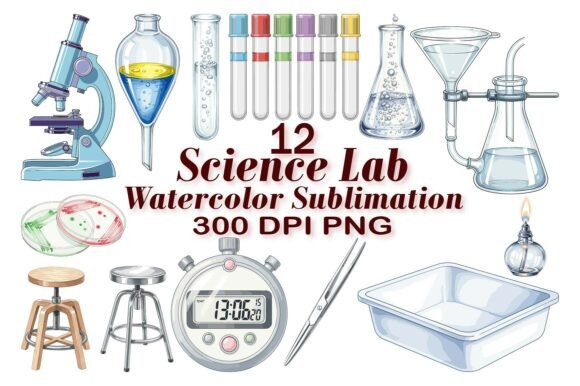
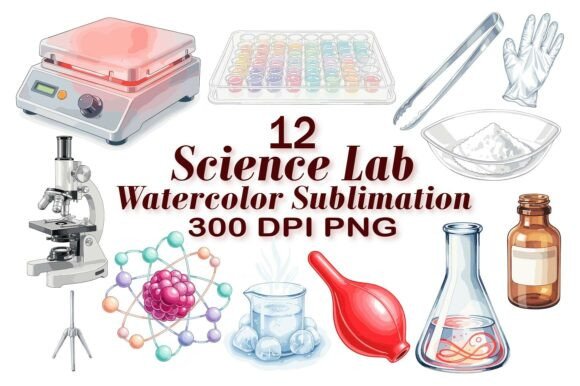
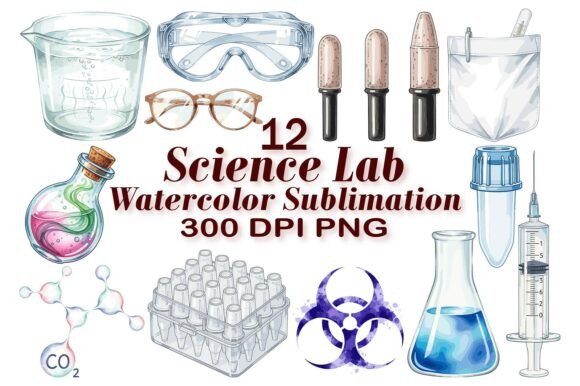
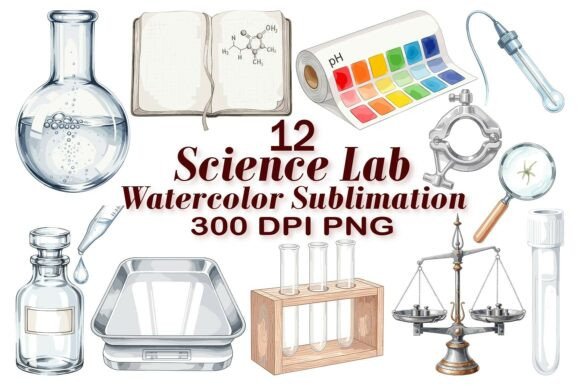
Science Lab Watercolor Clipart refers to digital illustrations of laboratory equipment rendered in a style that mimics traditional watercolor painting. These assets typically feature translucent layers, visible brush strokes, and soft edges where colors bleed into one another. The subject matter usually encompasses essential lab tools such as Erlenmeyer flasks, beakers, pH probes, balances, centrifuge tubes, and chemical structures.
What distinguishes this format from standard clipart is its aesthetic versatility. Traditional scientific illustrations often prioritize clinical precision, utilizing stark lines and flat colors to ensure accuracy. While necessary for technical manuals, this approach can sometimes feel sterile for broader audiences. In contrast, watercolor styles soften the perception of science, making it appear less intimidating and more inviting. This is particularly valuable when creating materials for younger students or when aiming to humanize the research process in marketing materials.
The high resolution inherent in professional collections—often reaching 5000 x 5000 pixels at 300 DPI—ensures that the delicate textures of the paint do not pixelate upon scaling. This level of detail allows the subtle gradients of a blue liquid in a test tube or the metallic sheen of a clamp to remain crisp, whether viewed on a screen or printed on a large poster.
Comparing Formats: Watercolor vs. Vector and Realism
When evaluating visual resources, it is crucial to compare Science Lab Watercolor Clipart against other prevalent formats to determine the best fit for specific projects. The primary alternatives are vector graphics and photorealistic images.
Vector Graphics are defined by mathematical paths, allowing them to scale infinitely without quality loss. They are ideal for logos, icons, and designs requiring sharp, clean lines. However, vectors often lack the textural depth found in watercolor. If a project requires a hand-drawn, artisanal feel, vectors may appear too mechanical unless heavily stylized with custom effects, which adds significant production time.
Photorealistic Images offer absolute accuracy but come with their own limitations. High-resolution photos of labs can be visually heavy and difficult to integrate into graphic layouts without obscuring text. They also require careful color grading to match the surrounding design elements. Furthermore, using real photos can sometimes distract from the core message, drawing attention to the background clutter rather than the concept being taught or sold.
Watercolor Clipart occupies a middle ground. It retains enough detail to be recognizable—allowing a user to clearly identify a pipette versus a dropper—while providing the artistic flexibility to blend seamlessly with various backgrounds. This makes it superior for sublimation printing on apparel, where the soft edges prevent harsh outlines that might crack or fade over time, and for scrapbooking, where the artistic texture complements paper-based aesthetics.
Evaluating Strengths and Tradeoffs
Every design resource comes with tradeoffs. Understanding these helps in making an informed decision about whether Science Lab Watercolor Clipart is the right tool for your needs.
Strengths:
- Aesthetic Appeal: The organic nature of watercolor adds warmth and creativity, breaking the monotony of standard educational slides or corporate reports.
- Versatility: These files work exceptionally well for sublimation on mugs, t-shirts, and tote bags. The soft gradients mimic fabric dyes naturally, avoiding the "sticker-like" appearance common with solid-color vectors.
- Engagement: For educators, using artistic illustrations can increase student engagement. A lesson on acid-base reactions featuring vibrant, hand-painted pH paper and flasks is often more memorable than a black-and-white diagram.
- Layout Flexibility: Because many watercolor PNGs come with transparent backgrounds, they can be layered over text, patterns, or photographs without needing complex masking.
Tradeoffs and Limitations:
- Scalability Limits: While high-resolution (300 DPI) files are excellent for print, they are not infinite like vectors. Enlarging a raster image beyond its native resolution will eventually result in pixelation. Users must ensure the file size matches their intended output dimensions.
- Technical Precision: These images are artistic interpretations, not technical schematics. They should not be used for engineering blueprints or detailed procedural instructions where exact measurements and component visibility are critical.
- Color Consistency: Watercolor effects rely on color blending. When printing on different substrates (e.g., dark fabrics vs. white paper), the translucency of the paint effect may behave differently, requiring careful previewing before mass production.
Ideal Use Cases and Decision Factors
Determining when to utilize Science Lab Watercolor Clipart depends largely on the goal of the project. Here are scenarios where this format excels, alongside situations where alternative resources might be preferable.
When Watercolor Is the Right Choice
This style is the optimal choice for educational branding. Schools, tutoring centers, and science camps often use these assets to create a welcoming atmosphere. For instance, a classroom door decoration featuring watercolor beakers and magnifying glass illustrations creates an immediate sense of curiosity without appearing overly academic.
It is also highly effective for apparel and merchandise. Designs for science-themed weddings, birthday parties, or teacher appreciation gifts benefit from the softer look. A t-shirt featuring a watercolor flask and chemical structure reads as a stylish fashion statement rather than a promotional uniform. Similarly, for stationery and invitations, the artistic flair elevates greeting cards and wedding invites, adding a touch of elegance that flat clipart cannot achieve.
Furthermore, for sublimation projects, the variety in a typical bundle—ranging from scales and balances to organic chemistry structures—provides a cohesive set of elements. The high DPI ensures that when transferred onto ceramic mugs or metal tumblers, the details of the brushwork remain intact, resulting in a premium finish.
When to Consider Alternatives
If the objective is technical instruction, such as a step-by-step guide on how to calibrate a pH probe or assemble a distillation apparatus, realistic photos or precise line-drawing vectors are superior. The ambiguity of watercolor washes could obscure critical details needed for safety or accuracy.
Additionally, if the design requires extreme scalability—such as a logo that must be printed on both a business card and a billboard—vector formats are the safer investment. While 5000x5000 pixel PNGs are substantial, they have a hard limit compared to the infinite scalability of SVG or EPS files.
Practical Application in Creative Endeavors
Integrating these assets into a workflow is straightforward, provided the user understands the file properties. Most modern design software handles PNG files with transparency effortlessly. For example, a designer creating a poster for a local science fair can layer a watercolor test tube rack over a textured paper background. The semi-transparent edges of the paint allow the background texture to show through slightly, creating depth and cohesion.
For those involved in scrapbooking and printable decorations, the ability to mix and match elements is key. A collection containing items like clamps, droppers, bottles, and books allows for the creation of unique compositions. One might arrange a cluster of colorful liquids in flasks to represent diversity in a biology class, or use a single, isolated balance scale to symbolize fairness in a chemistry ethics discussion.
The inclusion of specific tools like the pH probe and centrifuge tube in these bundles addresses niche needs that generic "science" packs often miss. This specificity allows creators to target particular subjects, such as organic chemistry or environmental analysis, with greater accuracy while maintaining the artistic integrity of the watercolor medium.
Conclusion on Selection Strategy
Selecting the right visual assets is a balance between aesthetic goals and functional requirements. Science Lab Watercolor Clipart offers a compelling solution for those seeking to infuse creativity, warmth, and approachability into scientific themes. It bridges the gap between the rigidity of technical data and the expressiveness of art. While it may not replace the need for precise vectors or photographic evidence in technical contexts, its value in education, marketing, and personal expression is undeniable.
By weighing the strengths of texture and engagement against the limitations of scalability and technical precision, designers and educators can confidently decide when this style serves their vision best. Whether producing high-quality sublimation products, engaging classroom materials, or unique event invitations, these artistic resources provide a robust foundation for creative endeavors.